
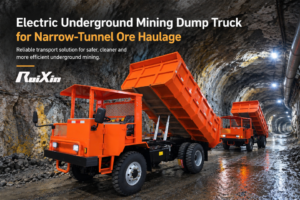
Electric Underground Mining Dump Truck for Narrow-Tunnel Ore Haulage
1. Project Background: Ore Transportation in Narrow Underground Tunnels
Underground mines often face transportation challenges caused by restricted tunnel dimensions, limited turning space, and the need to move ore efficiently between loading and unloading points. Conventional transport vehicles may be too large for some narrow passages, while frequent short-distance trips can increase operating costs and vehicle waiting time.
For this application scenario, an electric underground mining dump truck is considered for short-distance ore transportation in a narrow-tunnel mining operation. The main objective is to improve material handling flexibility while reducing exhaust emissions and operating noise in confined underground spaces.
RUIXIN provides electric and diesel mining dump trucks for different underground working conditions. For operations with suitable charging facilities and relatively short haul routes, an electric model can be a practical option.
2. Main Challenges in Underground Haulage
The operation needs to address several common challenges:
- Limited tunnel space: The vehicle must fit the available tunnel width and height while allowing sufficient clearance for turning.
- Frequent material transport: Repeated loading, hauling, unloading, and return trips require a practical balance between payload and maneuverability.
- Underground air quality: Electric equipment can eliminate exhaust emissions from the vehicle during operation.
- Restricted working areas: Compact dimensions help the vehicle access areas where larger transport equipment may be difficult to operate.
- Operating cost control: Battery charging, maintenance requirements, travel distance, and daily working hours must be considered together.
3. Equipment Selection and Technical Considerations
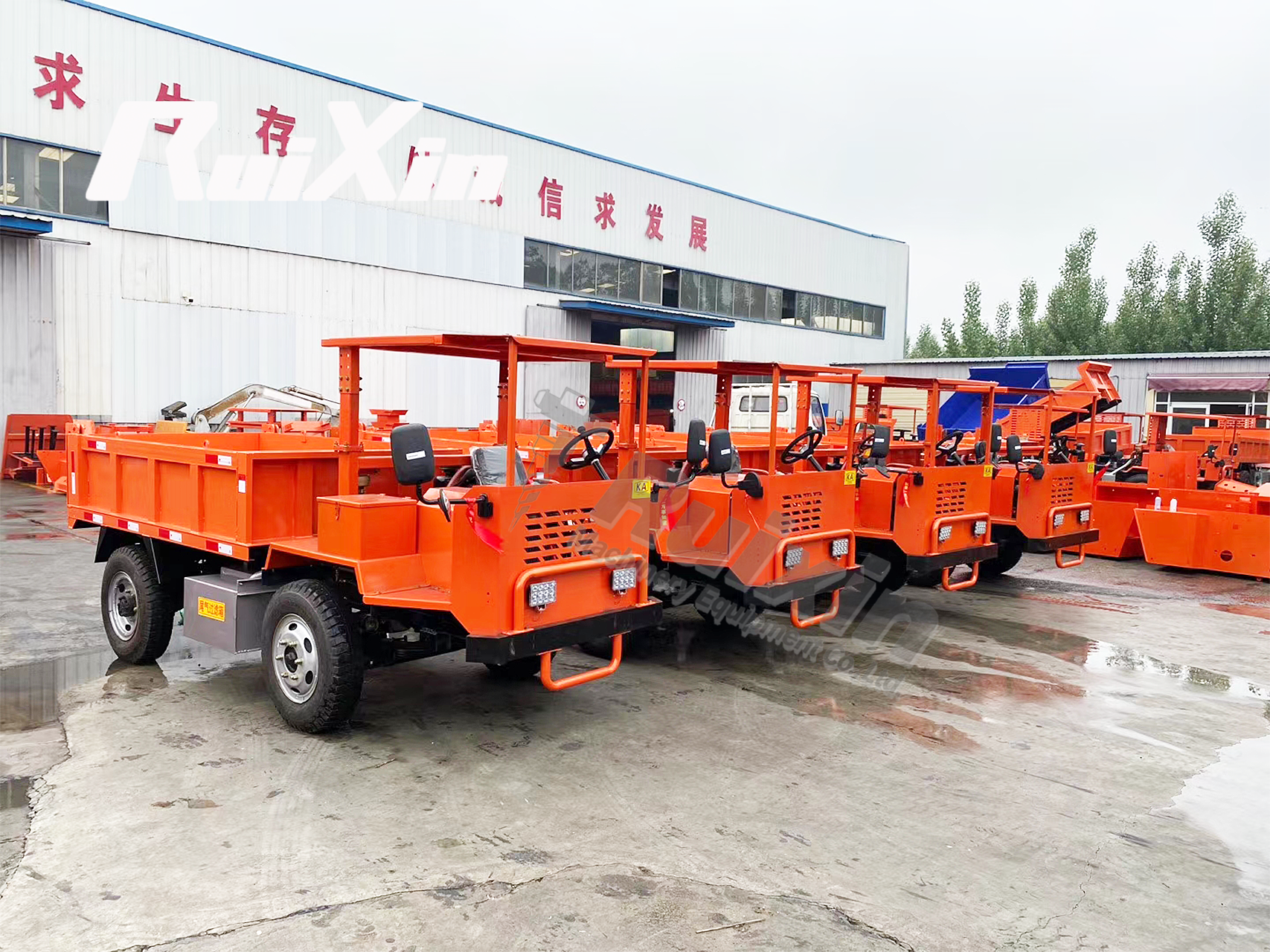
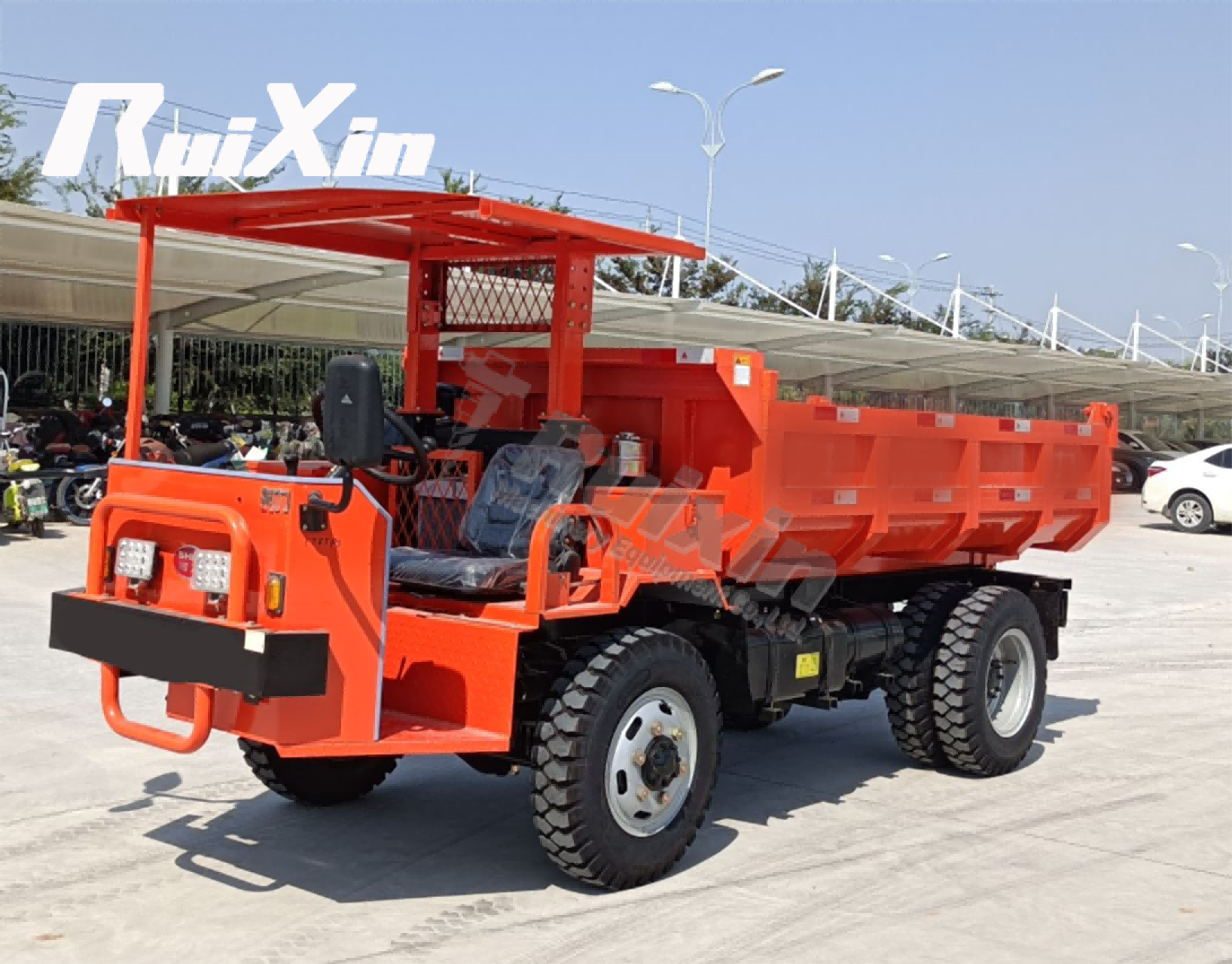
The RUIXIN 4-ton electric mining dump truck is a reference option for evaluating compact underground transport requirements.
Its published specifications include:
| Parameter | Reference Specification |
|---|---|
| Rated load capacity | 4 tons |
| Cargo box volume | 1.6 m³ |
| Overall dimensions | 4,000 × 1,520 × 1,420 mm |
| Cargo box dimensions | 2,600 × 1,500 × 450 mm |
| Motor power | 10 kW AC |
| Power supply | 72 V |
Specifications are based on the published product information. Confirm the selected configuration with RUIXIN before ordering.
Why Consider an Electric Mining Dump Truck?
Compact structure for narrow tunnels
With an overall width of approximately 1.52 m in the listed configuration, the truck can be evaluated for restricted underground roadways. Actual suitability depends on tunnel clearance, turning geometry, roadway condition, and safety requirements.
Reduced exhaust emissions at the point of use
An electric drive eliminates engine exhaust emissions during vehicle operation. This can be advantageous in confined working areas, although adequate mine ventilation and compliance with site regulations remain necessary.
Practical short-distance material handling
The 4-ton rated payload provides a reference for assessing smaller transport requirements. The appropriate capacity should be determined from ore density, loading volume, route length, and the number of trips required per shift.
Matching the truck with charging facilities
Before selecting an electric model, the mine should evaluate battery capacity, charging time, available charging locations, operating hours, and the required working range. The listed 72 V supply specification alone does not establish battery capacity or runtime; these details should be confirmed for the final configuration.
How to Estimate Daily Haulage Capacity
Daily transportation capacity depends on both payload and the number of completed trips.
Daily haulage capacity = Actual payload per trip × Completed trips per day
For example, if a truck carries an average of 3.5 tons per trip and completes 20 trips per day, its calculated daily haulage is:
3.5 tons × 20 trips = 70 tons/day.
This is an illustrative calculation, not a reported project result. Actual output depends on loading time, travel distance, road gradient, unloading time, charging requirements, and operating conditions.
4. Implementation and Operational Evaluation
A practical equipment implementation plan can follow four stages:
Stage 1: Site assessment
Measure tunnel width and height, turning areas, road gradients, haul distance, and loading and unloading locations. Confirm the daily transportation target and the available charging infrastructure.
Stage 2: Equipment configuration
Review the required payload, cargo box dimensions, motor configuration, battery specifications, braking system, and compatibility with the mine’s existing loading equipment.
Stage 3: Factory inspection and delivery
Before dispatch, confirm the agreed technical configuration and inspect key systems, including the electric drive, steering, braking, and hydraulic dumping functions where fitted. Packaging and transport arrangements should be matched to the destination and delivery requirements.
Stage 4: Site commissioning and performance monitoring
After delivery, verify operating clearance and conduct controlled loaded and unloaded test runs. Monitor payload, haul cycle time, energy consumption, charging intervals, and maintenance requirements to assess suitability for regular production.
5. Expected Operational Benefits
When the equipment is correctly matched to the site, the application may provide several benefits:
- More flexible movement through suitable narrow underground roadways.
- Reduced vehicle exhaust emissions and operating noise compared with a comparable diesel-powered vehicle.
- Mechanized ore transportation with less dependence on manual material handling.
- Better visibility into haulage performance through trip counts, payload records, and cycle-time monitoring.
The actual benefits should be evaluated using operating data collected after commissioning. No specific increase in productivity or reduction in operating costs should be assumed without verified site results.
6. Conclusion: Matching the Truck to the Mine
Selecting an underground mining dump truck requires more than comparing rated payloads. Tunnel dimensions, route conditions, loading equipment, daily output, and available energy infrastructure all influence the final decision.
For narrow-tunnel operations with suitable charging facilities, the RUIXIN 4-ton electric mining dump truck is one option to evaluate. Diesel models and larger payload configurations may be more appropriate for other haulage requirements.
Planning an underground ore transportation project? Send RUIXIN your tunnel dimensions, haul distance, road gradient, target daily output, and preferred power type. Our team can help assess a suitable mining dump truck configuration for your working conditions.
Related Products
- Mining Tricycle Series → Tricycle Dump Truck Series
- 2-Ton Mining Tricycle → 2-Ton Mining Tricycle
- Underground Dump Truck → Underground Mining Dump Truck
- Underground LHD Loader → Underground Mining Loader
Technical Review: RUIXIN EQUIPMENT Engineering Team
Published: October 10, 2026
Last Updated: October 10, 2026
 English
  Spanish
  Russian