
Underground Mining Dump Truck Capacity: Payload and Volume
Understanding Mining Dump Truck Capacity Before Buying
Choosing an underground mining dump truck requires more than checking its rated payload. The cargo box volume, material density, tunnel dimensions, haul distance, and loading equipment all affect how much material can be transported in each trip. A truck with a large cargo box may reach its weight limit before the box is full, especially when hauling dense ore. Conversely, a truck carrying lightweight broken rock may reach its volume limit first.
To select the right underground mining dump truck capacity, buyers should compare rated payload with the actual weight of the material loaded into the cargo box. This approach helps prevent overloading, reduces unnecessary trips, and improves transportation efficiency. Working with an experienced mining equipment manufacturer also makes it easier to match truck specifications to actual underground operating conditions.
1. Payload Capacity and Cargo Box Volume: What Is the Difference?
Two specifications are particularly important when evaluating a mining dump truck.
Rated payload: The maximum material weight the truck is designed to carry under its specified operating conditions.
Cargo box volume: The internal volume available for loading ore, waste rock, and other bulk materials.
These specifications are related, but they are not interchangeable. The weight of a full cargo box depends on the bulk density of the material, which varies according to its composition, particle size, moisture content, and degree of compaction.
For example, a truck with a 4.1 m³ cargo box does not automatically carry 8.2 tons of material. That load would require an average bulk density of 2.0 tons/m³, and the truck’s rated payload must also permit that weight.
When comparing underground mining dump trucks, buyers should evaluate both specifications rather than selecting a vehicle based on cargo box volume alone.
2. How to Calculate the Required Mining Dump Truck Capacity
A simple calculation can help estimate whether the cargo box or the rated payload will limit the load.
Formula:
Material Weight (tons) = Cargo Box Volume (m³) × Bulk Density (tons/m³)
The estimated usable load should not exceed the truck’s rated payload.
Example: RUIXIN 8-Ton Mining Dump Truck
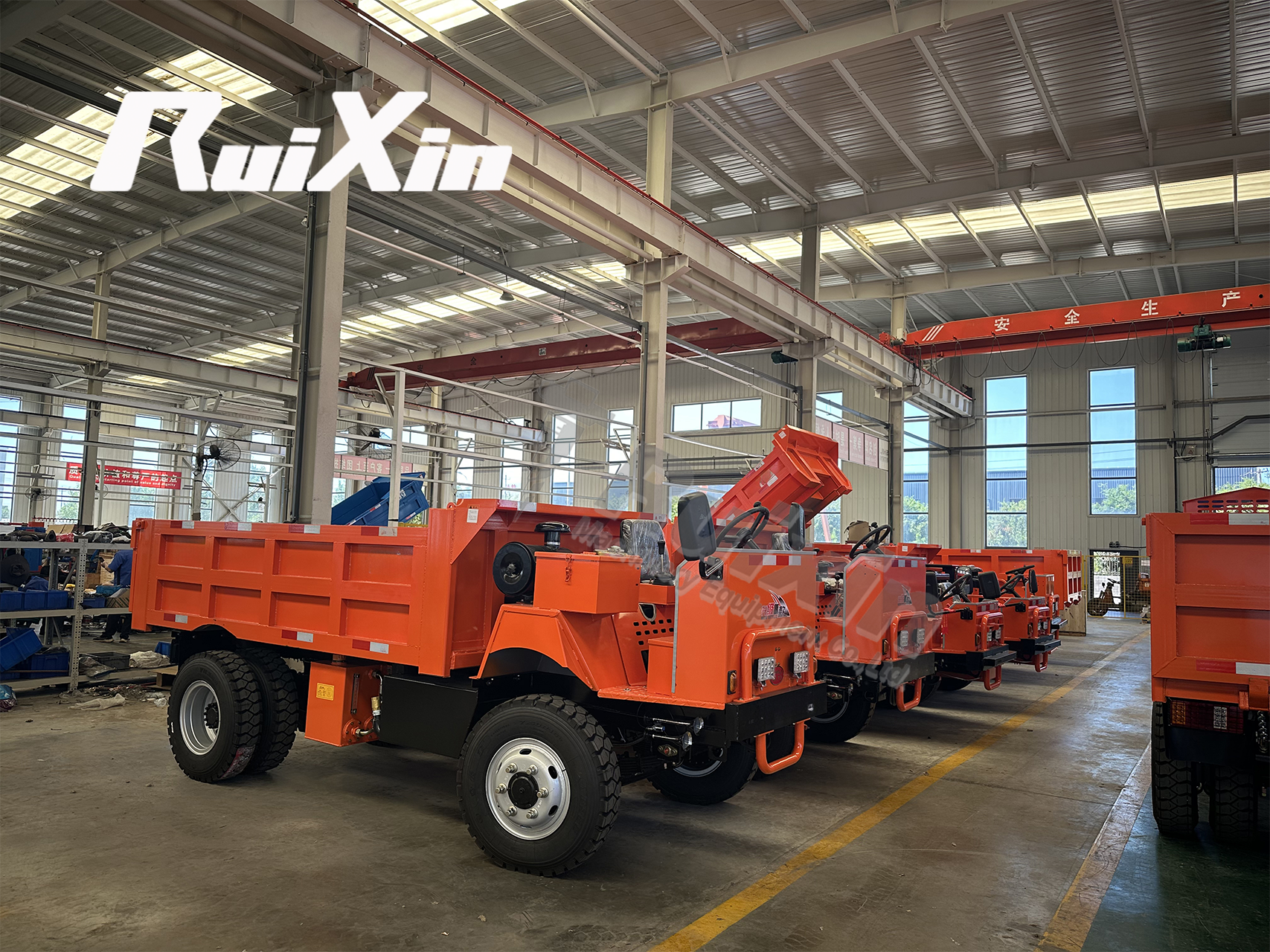
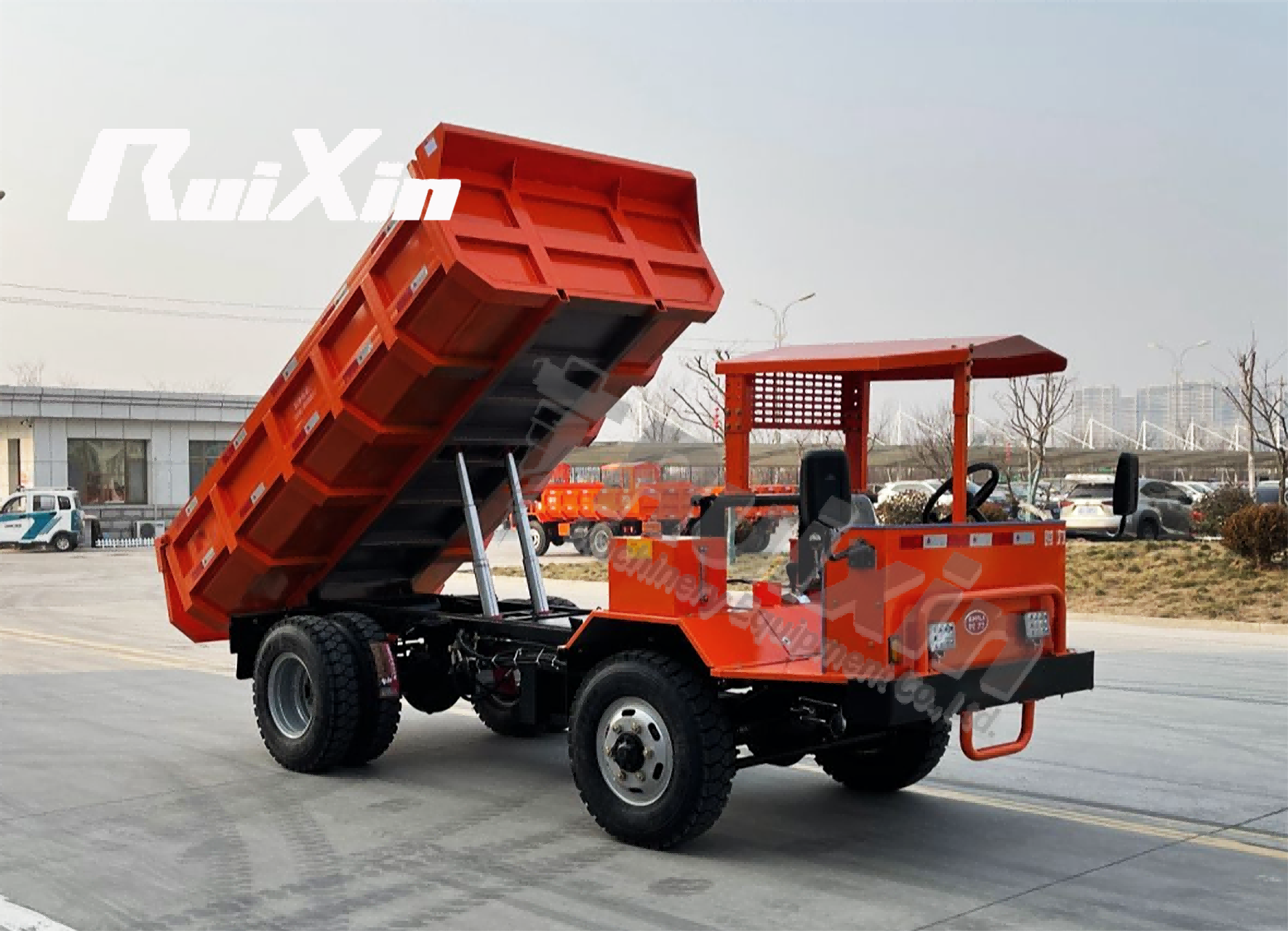
RUIXIN lists an 8-ton hydraulic self-discharge mining transport dump truck with a 4.1 m³ cargo box. Its listed overall dimensions are 5,200 × 1,770 × 1,750 mm.
Assuming the truck is loaded to the full nominal cargo box volume, the following table illustrates how different material densities affect the estimated load.
| Assumed Bulk Density | Cargo Box Volume | Calculated Material Weight | Result |
|---|---|---|---|
| 1.5 t/m³ | 4.1 m³ | 6.15 tons | Volume limit reached first |
| 2.0 t/m³ | 4.1 m³ | 8.20 tons | Payload limit reached first |
| 2.5 t/m³ | 4.1 m³ | 10.25 tons | Payload limit reached first |
These are illustrative calculations, not measured operating results. Actual bulk density, loading shape, material distribution, and the manufacturer’s rated payload must be considered.
For material with a bulk density of 2.0 t/m³, the theoretical weight at full box volume would exceed the truck’s 8-ton rated payload. The operator must therefore stop loading before reaching the full nominal volume.
See the RUIXIN 8-Ton Mining Dump Truck for the listed specifications.
3. Which Capacity Is Suitable for Your Mining Operation?
The appropriate payload depends on the production target and available underground working space. The following ranges provide a starting point for evaluating different operations.
| Payload Range | Potential Application | Main Consideration |
|---|---|---|
| 1–5 tons | Narrow tunnels, small-scale mines, short-distance haulage | Compact dimensions and maneuverability |
| 8–12 tons | General underground ore and waste-rock transportation | Balance between payload and tunnel clearance |
| 14–20 tons | Higher-volume haulage operations | Roadway dimensions, turning space, and production demand |
These are general application guidelines rather than fixed rules. A smaller truck may be more productive in a restricted tunnel, while a higher-payload vehicle may be more appropriate for a mine with adequate clearance and greater transportation demand.
RUIXIN EQUIPMENT, a professional mining machinery manufacturer, offers underground mining dump trucks in multiple payload configurations. The final model should be selected according to the actual mine layout, material characteristics, and operating requirements.
Explore the Underground Dump Truck Product Range to compare available models.
4. Match the Truck to Material Density and Loading Equipment
The truck should be evaluated as part of the complete underground loading and transportation system.
Consider the material being transported
Ore and waste rock can have significantly different bulk densities. Before selecting a truck, determine the approximate density of the broken material in its loaded state rather than relying only on the density of solid rock.
For lightweight material, cargo box volume may be the limiting factor. For dense ore, rated payload and axle-load limits may be reached before the cargo box is full.
Check compatibility with the loader
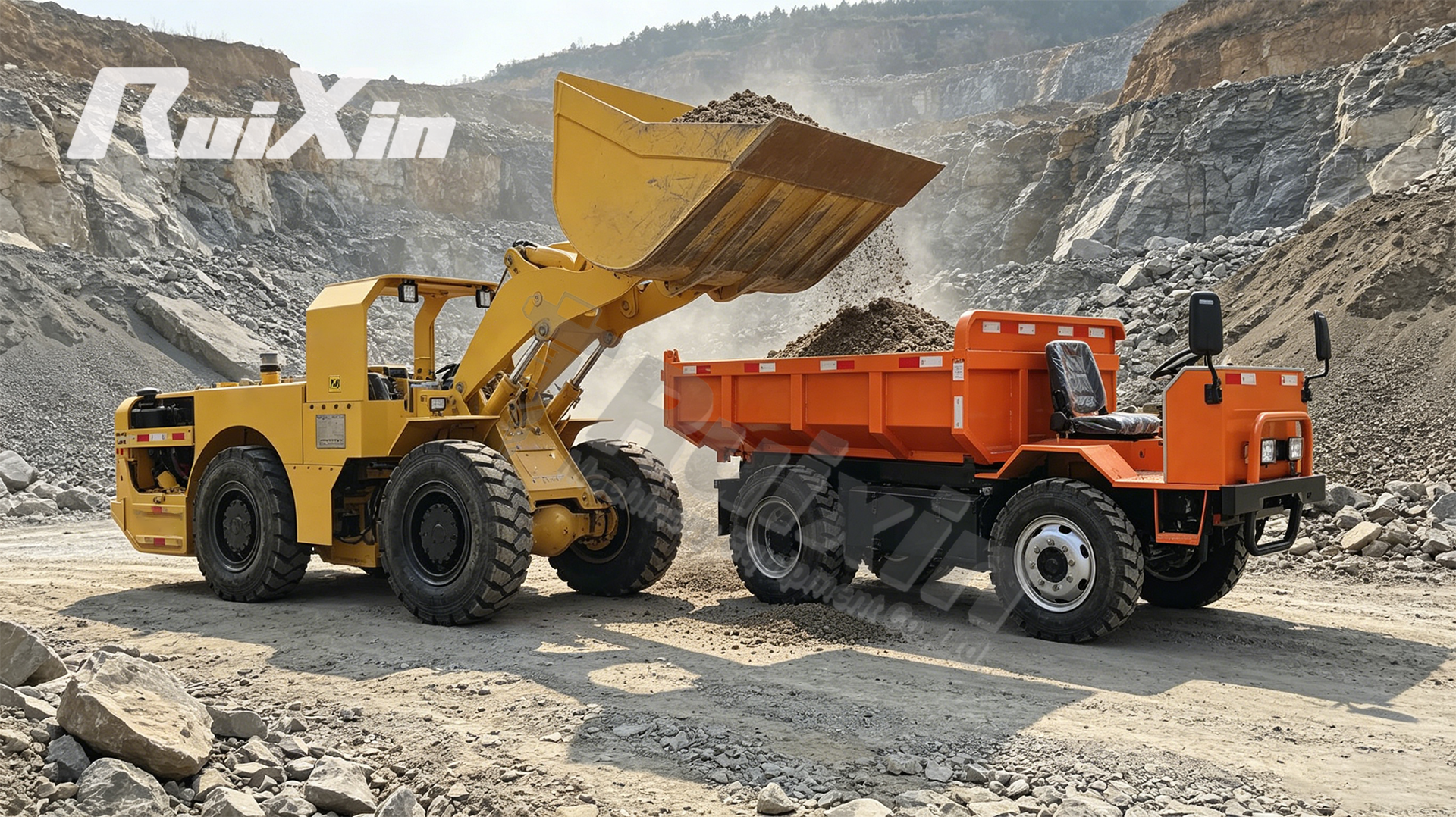
The loader’s bucket capacity and the truck’s cargo box dimensions influence loading time and load distribution. A suitable combination allows the operator to fill the truck efficiently without repeatedly adjusting the loading position or exceeding the rated payload.
For mines using both loading and haulage equipment, consider the compatibility of the truck with an Underground Mining LHD Loader. Bucket capacity, material density, and the number of loading cycles should all be evaluated together.
Evaluate the complete haulage cycle
Daily transportation depends on more than payload per trip.
Daily Haulage = Average Payload per Trip × Completed Loaded Trips per Day
For example, if a truck carries an average of 7.5 tons per trip and completes 20 loaded trips per day, its calculated daily haulage is 150 tons.
This is an illustrative estimate, not a guaranteed production figure. Actual output depends on loading and unloading time, travel distance, road gradient, traffic, maintenance, and operating conditions.
A larger truck is not necessarily the better choice if it reduces maneuverability or increases cycle time.
5. Diesel or Electric: Which Power System Should You Consider?
After establishing the required payload and cargo box volume, buyers should evaluate the power system.
Diesel mining dump trucks may be suitable for operations that prioritize flexible deployment and extended operation between refueling stops. Engine performance, climbing capability, braking, and ventilation requirements should be reviewed for underground use.
Electric mining dump trucks can reduce exhaust emissions at the point of use and may be advantageous where charging infrastructure and operating schedules support electric operation. Buyers should check battery capacity, charging time, expected working hours, and available charging facilities.
RUIXIN offers both diesel and electric underground mining transport options. For example, its published Electric Underground Mining Dump Truck for Narrow-Tunnel Ore Haulage provides a reference for evaluating compact electric haulage equipment.
The final choice should reflect the mine’s ventilation arrangements, duty cycle, infrastructure, maintenance resources, and total operating cost.
6. Common Mistakes When Selecting Mining Dump Truck Capacity
Several mistakes can affect equipment performance and operating costs.
Selecting a truck based only on its rated payload. The cargo box must also accommodate the required material volume, and the vehicle must fit the available roadway.
Ignoring material density. Dense ore can reach the truck’s weight limit before the cargo box is full. Estimate the loaded material density before calculating capacity.
Choosing a larger truck without checking tunnel clearance. Overall width, height, turning geometry, and unloading space must be confirmed before ordering.
Overlooking the loading system. A mismatch between loader bucket size and truck cargo box dimensions may increase loading time or make it difficult to distribute the load evenly.
Comparing purchase prices without considering operating costs. Fuel or electricity consumption, maintenance, spare parts, downtime, and expected service life all influence the cost per ton transported.
For a practical project reference, read the African Copper Mine: 8-Ton Mining Dump Truck for Improved Mining Haul Cycle Time. It illustrates why mine conditions and transportation-cycle requirements should be considered alongside payload.
Frequently Asked Questions
1. What is the difference between rated payload and cargo box volume?
Rated payload is the maximum permitted material weight, while cargo box volume describes the available loading space. Actual load weight depends on the bulk density and distribution of the material.
2. How do I calculate the required mining dump truck capacity?
Multiply the usable cargo box volume by the bulk density of the material to estimate its weight. Compare the result with the rated payload and confirm that the truck can operate safely under the intended conditions.
3. Is a larger mining dump truck always more efficient?
No. A larger truck may carry more material per trip, but restricted tunnel clearance, turning difficulty, longer loading times, and roadway conditions can reduce overall productivity.
4. What information is needed to select an underground mining dump truck?
Prepare the tunnel width and height, turning space, haul distance, road gradient, material type and bulk density, daily production target, and available loading equipment. These details help determine the suitable payload, vehicle dimensions, and power system.
5. Can a mining dump truck manufacturer customize equipment for a specific mine?
Customization may be possible depending on the model and technical requirements. As a mining equipment manufacturer, RUIXIN can discuss application-specific requirements with customers and evaluate suitable configurations. Confirm the available customization options with the engineering team before ordering.
Work with a Mining Dump Truck Manufacturer
Selecting the right underground mining dump truck starts with the material being transported and the conditions in which the vehicle will operate. Rated payload, cargo box volume, material density, loader compatibility, and tunnel dimensions should be assessed together to achieve a practical balance between productivity and operating cost.
RUIXIN EQUIPMENT is a mining machinery manufacturer specializing in underground mining dump trucks, LHD loaders, and mining tricycles. With more than 40 years of manufacturing experience, the company provides equipment options for different underground mining and tunneling applications.
To discuss a suitable model for your project, send us the following information:
Required payload or target daily haulage
Tunnel width and height
Material type and approximate bulk density
Haul distance and road gradient
Preferred diesel or electric power system
Contact RUIXIN EQUIPMENT through our official website to discuss your application and request a suitable equipment recommendation.
Technical Review: RUIXIN EQUIPMENT Engineering Team
Published: October 19, 2026
Last Updated: October 19, 2026

 English
 Spanish
 Russian