The”Golden Dimension” for Narrow Vein Mining: 1.6m Truck Width
In underground trackless transportation, a 1.6-meter vehicle width is widely recognized as the “Golden Ratio” for mini dump trucks. This is not an arbitrary figure; it represents the precise equilibrium reached between tunnel excavation costs, support safety, and equipment operational efficiency.
The following four core logical pillars support this “Magic Dimension”:
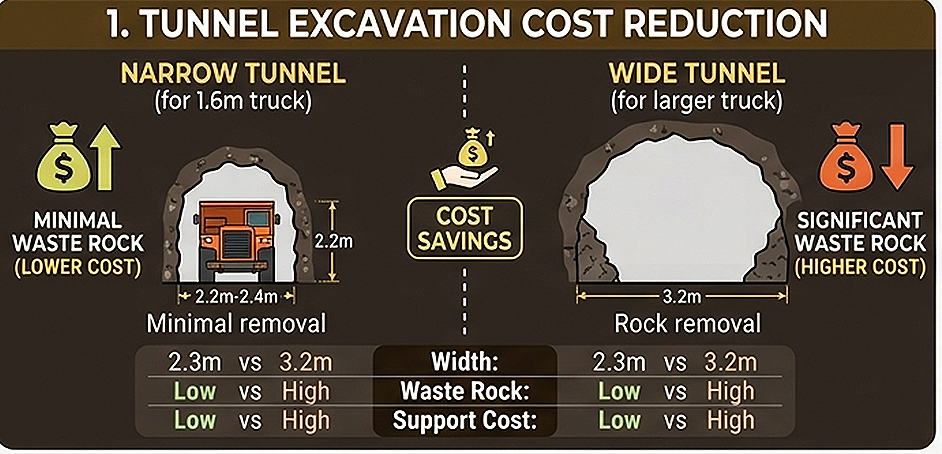
1. The “Watershed” of Tunnel Excavation Costs
In underground mining, every additional centimeter of tunnel width translates into significant capital expenditure.
Mucking Volume vs. Cost: Wider tunnels result in a higher volume of waste rock (slag) produced by blasting. Expanding a tunnel from 2.2m to 3m isn’t just an 80cm increase in width—it is a massive increase in the total cross-sectional area. A 1.6m wide chassis typically allows the net tunnel width to be restricted to 2.2m–2.4m.
Support Costs: As tunnel span (width) increases, the pressure on the roof grows exponentially. While a 2.2m wide tunnel may only require basic rock bolting, exceeding 3m often necessitates expensive steel arches or dense shotcrete.
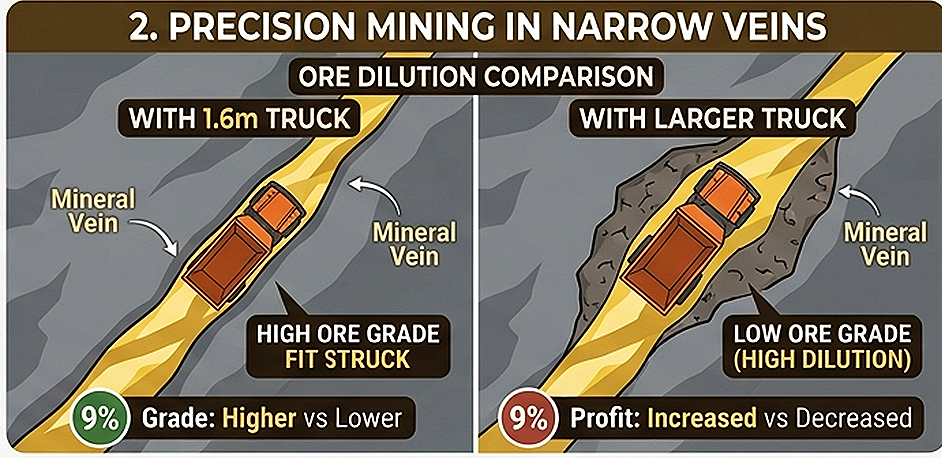
2. Precision Extraction in Narrow Veins
Many high-grade gold and chromium mines in Africa and globally are characterized by “Thin Veins.”
Lowering Dilution Rates: If a mineral vein is only 1m wide, but a 3.5m tunnel must be excavated to accommodate large trucks, the remaining 2.5m is valueless waste rock. This severely “dilutes” the ore grade.
Precision Matching: A 1.6m wide body allows miners to enter the vein with minimal disturbance, ensuring that every bucket of material hauled contains a higher concentration of precious metals.
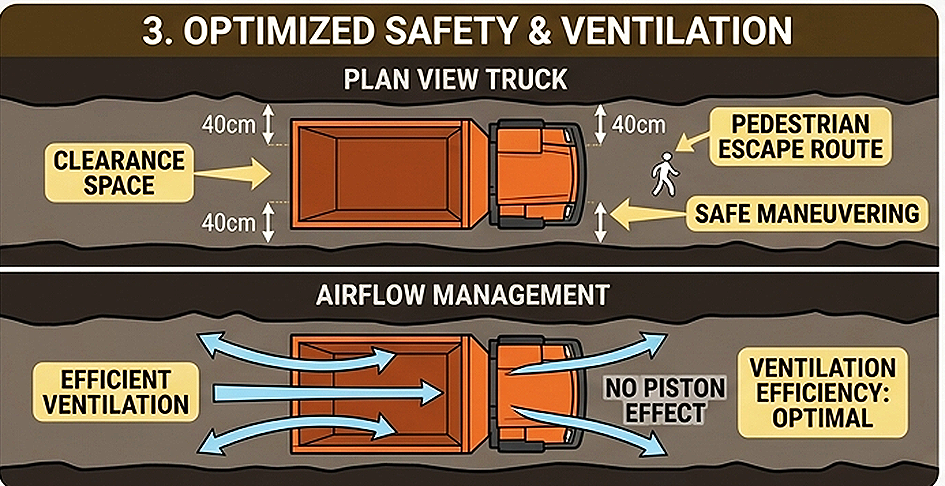
3. Safety Redundancy and the “Buffer Zone”
When operating in narrow galleries, vehicles must maintain sufficient clearance for both safety and ventilation.
Operational Margins: A 1.6m truck operating in a 2.4m tunnel provides approximately 40cm of buffer space on each side. This prevents the vehicle from scraping against jagged mine walls and provides a critical emergency escape route for underground personnel.
Ventilation Efficiency: Tunnels act as the “respiratory system” of the mine. If a vehicle is too wide (occupying over 80% of the cross-section), it creates a “piston effect,” blocking fresh air flow and making smoke clearance difficult. The 1.6m ratio ensures air can circulate effectively around the vehicle.
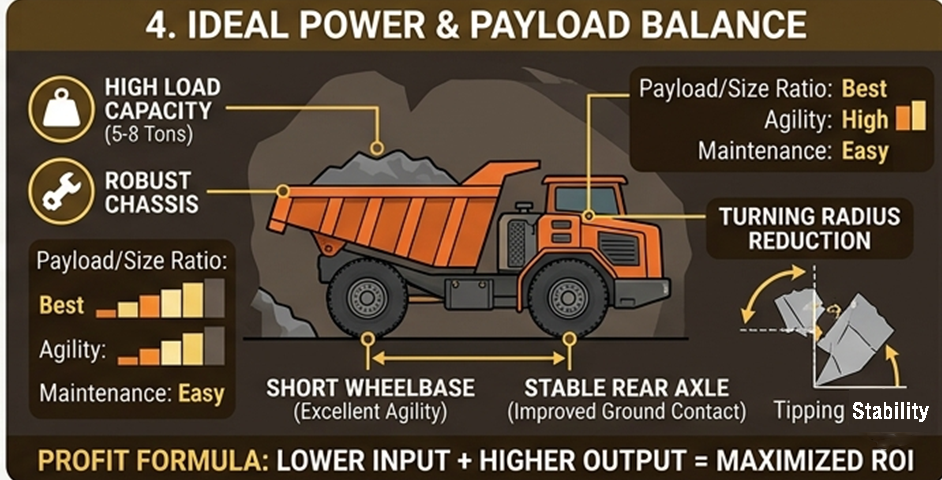
4. The Ideal Balance of Power and Payload
Engineering performance is maximized on a 1.6m wide chassis:
Stability & Center of Gravity: Compared to narrower units (e.g., 1.2m), the 1.6m width provides a sufficient track width to prevent rollovers on uneven underground terrain.
Payload Capacity: This width is ample for accommodating reinforced rear axles and dual-tire configurations. This enables a 1.6m wide truck to carry 5 to 8 tons of ore—the most efficient transport volume for single-cycle operations in small-to-medium mines.
Summary
1.6 meters is more than just a dimension; it is a profitability formula.
It guarantees lower excavation investment, delivers higher ore grades, and ensures operational safety. For mine owners in Africa seeking rapid ROI in narrow vein operations, choosing this size means hitting the “Sweet Spot” where input meets maximum output.


 English
  Spanish
  Russian