
How do mining dump trucks adapt to the complex terrain of mines?
Mining dump trucks are crucial equipment in mining operations, responsible for important tasks such as transporting ores, equipment, and personnel. According to mining dump truck manufacturers, due to the complex and changeable terrain of mines, mining transport vehicles need to have excellent adaptability and strong off-road capabilities to operate stably in mining areas with rough terrain, muddy and slippery surfaces, or steep slopes. How to enable mining transport vehicles to exert optimal performance in the complex terrain of mines has become a key issue in mine production.
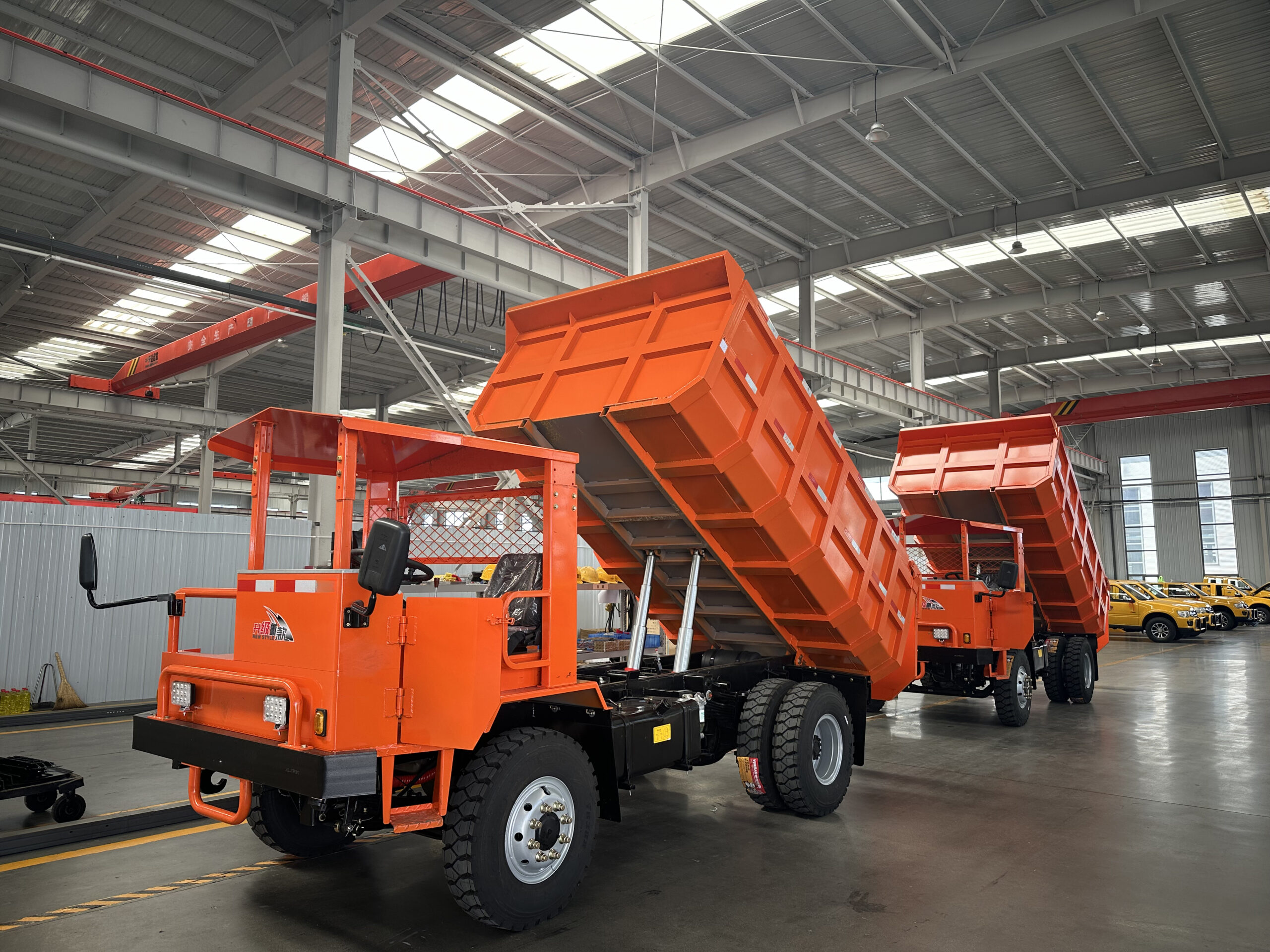
The complexity of mine terrain is reflected in its irregular slopes and narrow operating spaces. In most mines, especially underground or open-pit mines, steep slopes, potholes, and uneven roads are common occurrences, which place higher demands on the power systems and drive modes of mining transport vehicles. Mining transport vehicles are usually equipped with a powerful four-wheel drive system and a high-torque engine, which can provide strong power output and traction, enabling the vehicles to travel stably on steep slopes. In addition, the vehicle chassis is designed with a relatively high ground clearance to avoid chassis scratches on uneven ground and ensure smooth transportation.
In addition to a powerful power system and slope-adaptability, the tire design of mining transport vehicles also plays a crucial role. Mine ground is often covered with mud, gravel, or standing water, and these factors significantly increase driving difficulty. For this reason, the tires of mining transport vehicles usually use special wear-resistant materials and are designed with deep tread patterns, ensuring sufficient grip even on slippery or soft ground. For different mine terrains, vehicles can also be equipped with different types of tires to adapt to various ground conditions such as hard rock and soft soil, thereby improving driving stability and safety.
The steering and suspension systems of mining transport vehicles also play a crucial role in adapting to complex terrain. On rough mine roads, the vehicle’s steering system needs to be responsive to ensure that the mining transport vehicle can turn flexibly in narrow spaces. Many mining transport vehicles are equipped with a hydraulic power steering system and an all-wheel steering design, which makes the vehicle’s steering more flexible and smooth in tight spaces. In terms of the suspension system, mining transport vehicles are usually fitted with reinforced suspension devices that can effectively absorb the impact force from the ground, reduce the vehicle’s vibration on complex terrain, improve driving comfort, and at the same time protect the vehicle body and transported goods from damage.
With the diversification of mine operating environments, the intelligence and automation of mining transport vehicles have gradually become key factors in enhancing their adaptability. In some high-altitude or extreme environments, mining transport vehicles can reduce the interference of manual operations and ensure the safety and efficiency of the transportation process by being equipped with intelligent driving systems, GPS positioning, and automatic obstacle avoidance functions. Through these intelligent systems, mining transport vehicles can not only adapt to complex mine terrain but also effectively avoid traffic accidents and improve operational efficiency.
The structural design of mining transport vehicles also needs to be adjusted according to the working environment of the mine. For example, in coal mines or mining areas with explosion risks, the vehicle’s electrical system and engine must comply with explosion-proof standards to prevent fires or explosions caused by short circuits of electrical equipment or other faults. In addition, anti-corrosion treatment of the vehicle body is also crucial. Since the mine environment is usually humid and highly corrosive, the bodies of mining transport vehicles often require special anti-corrosion coating treatment to extend their service life and maintain the vehicle’s stable performance.
During the actual operation of mining transport vehicles, they also need to adapt to different load and transportation requirements. Mining transportation tasks usually have high load demands, so transport vehicles must have sufficient load-bearing capacity to adapt to the transportation of heavy ores and materials. To ensure the stability and driving capability of transport vehicles under load conditions, the frames of mining transport vehicles usually use high-strength steel and are designed with reinforced structures, which ensure that they can still maintain good traction and stability under high loads.
Overall, for mining transport vehicles to adapt to the complex terrain and operating environment of mines, they rely not only on modern power systems and special tire designs but also on the support of flexible steering systems, stable suspension systems, and intelligent technologies. As the mining environment continues to change, the technology of mining transport vehicles is also constantly innovating. From traditional mechanized vehicles to today’s intelligent and automated transport vehicles, the adaptability of mining transport equipment has been significantly improved, ensuring the safety and stability of mine production. Mining transport vehicles will continue to play an indispensable and important role in complex mine terrain, becoming a crucial piece of equipment essential for mine production.
Recent Posts
 English
  Spanish
  Russian